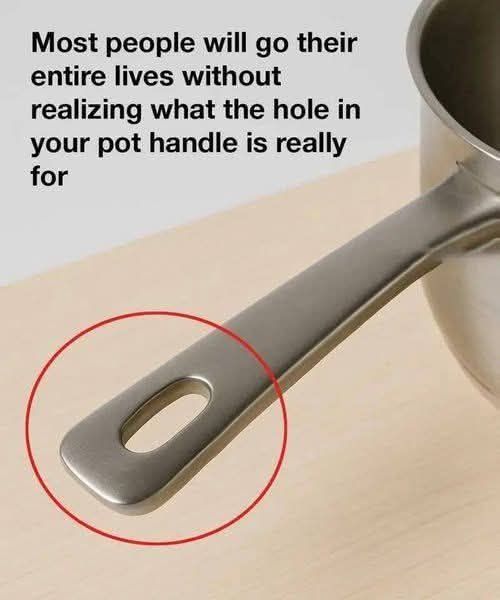
One of the most ingenious uses of the pot handle hole is as a resting spot for your cooking spoon or utensil.
Think about it — you’re making soup or a sauce and stirring regularly. Normally, you’d set your spoon on a napkin, plate, or (let’s be honest) straight on the counter. But that creates a mess.
Instead, slide the handle of your spoon through the pot handle hole. Let the head of the spoon rest over the edge of the pot. Not only does this keep the spoon right where you need it, but it also lets any drips fall back into the pot — no extra mess on your countertops.
This trick works best with slotted spoons, wooden utensils, or spatulas that have flat or rounded handles. It’s especially helpful when you’re short on counter space or trying to keep things tidy during busy meal prep.
2. A Space-Saving Storage Solution
While this one may seem more obvious, it deserves a proper spotlight: the hole in the handle is a vertical storage miracle.
Many kitchens struggle with limited cabinet space, especially for bulky items like frying pans and stockpots. Using the hole to hang your cookware on hooks or a pegboard frees up space and keeps your kitchen more organized. Plus, hanging pots and pans allows them to dry better, reducing the risk of trapped moisture and rust.
Whether you opt for a rustic wall-mounted rack, an overhead hanging bar, or a modern magnetic strip with hooks, using the handle hole for storage is a smart, aesthetic, and practical choice.
3. Controlled Pouring: A DIY Spout Hack
Ever tried to pour soup or sauce from a pot and ended up with more on the counter than in the bowl? We’ve all been there.
Here’s a clever workaround: insert a wooden spoon or long utensil into the handle hole and hold it firmly against the pot while you pour. The utensil acts like a guide or spout, helping to direct the flow of liquid and giving you more control over the pour.
This is especially useful for liquids with thicker textures, like stews, chowders, or homemade gravy. It’s also a neat trick for when you’re portioning food into meal prep containers or transferring liquids into narrow jars.
4. A Rough Measuring Guide (Surprise!)
It’s not an exact science, but the hole in a pot handle can occasionally serve as a makeshift measuring tool.
The size of the hole varies from pot to pot, but some are close to the size of:
A standard serving of uncooked spaghetti
A teaspoon to tablespoon quantity of dry goods