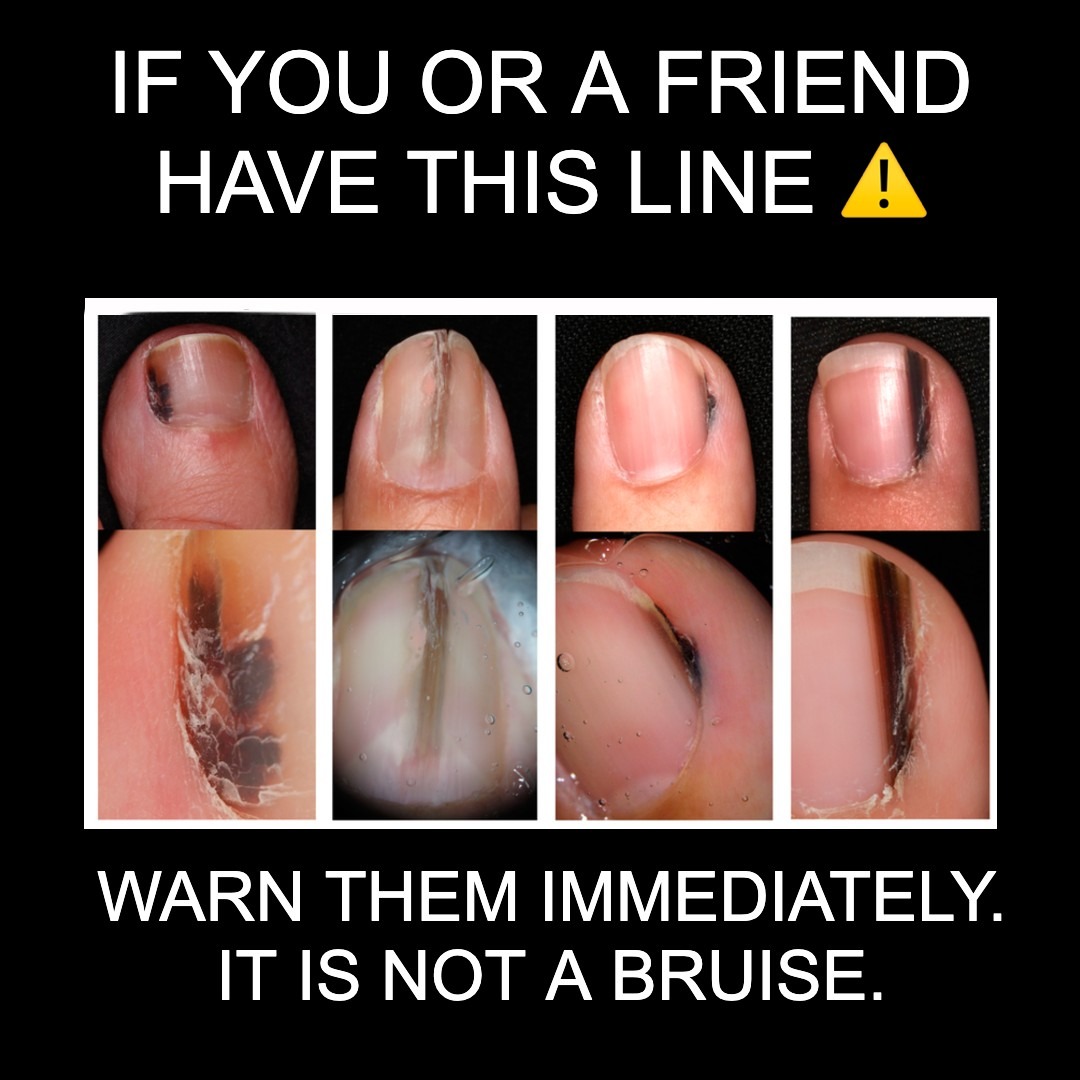
The Silent Mark: Why That "Line" on Your Nail Might Be Deadly
Most of us ignore our nails. If we see a dark mark or a bruise, we assume we smashed our finger in a door and forgot about it. But for thousands of people every year, that "bruise" is actually a rare, aggressive form of cancer hiding in plain sight.
It is called Subungual Melanoma. Unlike other skin cancers, it is not caused by the sun, and it doesn't care if you have dark skin or light skin. In fact, the "sun safety" rules we all know make us blind to this specific threat.
1. The Warning Sign: Hutchinson’s Sign
How do you tell the difference between a harmless bruise and a tumor? Doctors look for something called Hutchinson’s Sign.
Normally, a bruise or a mole stays under the nail. Hutchinson’s Sign occurs when the brown or black pigment spills out from under the nail and extends onto the skin of the cuticle or the fingertip.
This is the "Cardinal Warning." It means the cells have breached the nail unit and are spreading into the surrounding skin. If you see pigment on your cuticle, you need a doctor immediately.
2. The ABCDEF Rule: A Checklist for Your Nails
Because standard skin cancer rules don't work for nails, experts created a specific checklist to help you identify danger early.
- A for Age & Ancestry: This cancer peaks between ages 50–70. Crucially, it is the most common form of melanoma in African (up to 75% of cases) and Asian populations (25% in Chinese populations).
- B for Band: Look for a brown or black band. If it is wider than 3mm, it is a significant warning sign.
- C for Change: Is the band getting wider? Is the color changing? If a "bruise" doesn't grow out or disappear after treatment, it might not be a bruise.
- D for Digit: It loves the Thumb, the Big Toe (Hallux), and the Index finger. These fingers suffer the most trauma, which may play a role.
- E for Extension: This is Hutchinson’s Sign—pigment spreading onto the skin.
- F for Family History: A personal or family history of melanoma increases your risk.
3. The Tragedy of Bob Marley
The most famous case of Subungual Melanoma is the reggae icon, Bob Marley. In 1977, he noticed a dark spot under his toenail. He and his team assumed it was a soccer injury—a common mistake known as "recall bias" where we blame a specific event for a new symptom.
By the time it was diagnosed as cancer, doctors recommended amputating his toe. Marley refused due to his religious beliefs. He died four years later, at the age of 36, after the cancer spread to his brain and lungs.
4. Is it just a bruise? (How to tell)
A Subungual Hematoma (blood under the nail) is the most common misdiagnosis. Here is how to tell them apart:
- The Movement Test: A bruise is static. As your nail grows, the bruise should move upward, leaving clear, healthy nail at the bottom. Melanoma grows from the root (matrix), so the line will persist at the base of the nail.
- The Vitamin B12 Factor: Surprisingly, a Vitamin B12 deficiency can cause your nails to turn dark or develop streaks. This is reversible with vitamins, unlike cancer.
5. Don't Wait and See
Statistics show that 30% to 40% of these cancers are initially misdiagnosed as fungus or warts. This leads to an average delay of 9 months before proper treatment begins.
In the world of cancer, 9 months is the difference between a simple surgery and a life-threatening battle. If you have a vertical dark line on your nail that has been there for weeks and isn't growing out, do not use Google to diagnose it. See a dermatologist.